Published: 2026-07-05 — East London Roofers
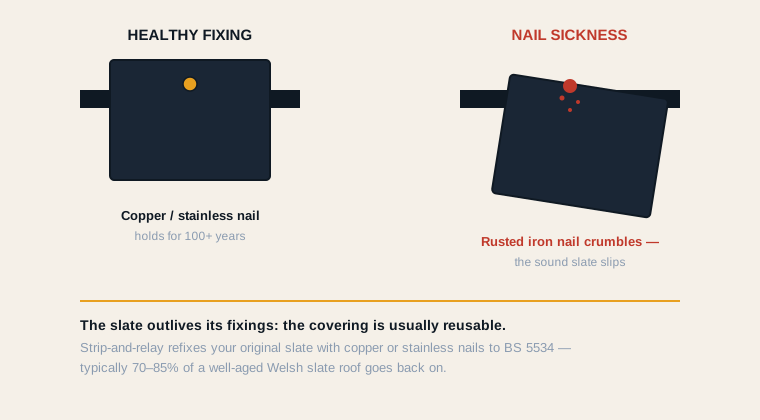
Nail sickness is the corrosion and expansion of the iron nails that fix roof slates to the battens beneath. As the nail corrodes, it expands — cracking the slate around the nail hole. The slate loses its fixing and begins to slip. Eventually it falls, exposing the batten and underlay beneath to weather.
The process is slow and predictable. Iron nails start corroding from the moment moisture reaches them. In London's humid, pollution-bearing air, nail sickness typically becomes a visible problem after 80–130 years. Given that Victorian terraces across Hackney, Bow, Bethnal Green, and Shoreditch were built 130–160 years ago, nail sickness is now the dominant roofing problem on these properties.
From ground level: Slipped slates are visible as dark lines where the underlay or batten is exposed between the courses. If several slates on the same slope have slipped, nail sickness is almost certainly the cause — a single slipped slate could be accidental, but multiple slips indicate corroded fixings.
From the loft: Red-brown rust stains on the underside of slates, visible around the nail holes. Rust crumbs on the insulation or loft floor below. Slates that move when pushed gently from beneath.
The lift test: If a roofer can lift slates by hand without resistance, the nails have corroded past the point of effective fixing. This test is definitive — sound nails hold slates firmly against lift.
Welsh slate has a proven lifespan of 100–200+ years. The slate itself is almost always reusable — the problem is the nails, not the covering. A strip-and-relay removes every slate, discards the corroded nails, and re-fixes the slates with copper nails that will not corrode for another 200+ years. Typically 70–85% of the original slate goes back on. The remaining 15–30% is replaced with matching Welsh or Spanish slate.
This is important because it means nail sickness does not require a new roof — it requires a re-fixing. The material cost is lower because most of the covering is reused. The main cost is labour: stripping, sorting, and re-laying 2,000–4,000 slates on a typical terrace is skilled, time-consuming work.
Day 1: Scaffold erected. Slates stripped methodically from ridge to eaves. Each slate is inspected, sorted (sound vs damaged), and stacked on the scaffold. Old battens and corroded nails removed. Underlay stripped.
Day 2: Full timber inspection — every rafter, purlin, wall plate, and ridge board examined. Rotten or weakened timbers repaired or replaced. New breathable membrane rolled out from eaves to ridge. Treated softwood battens fixed at the correct gauge for the slate size.
Days 3–4: Sound original slates re-fixed with copper nails (or stainless steel clips where appropriate). Replacement slates integrated. Valleys re-lined with Code 5 lead. Chimney flashings re-dressed. Ridge tiles fixed with dry ridge system.
Day 5: Final fixes, cleanup, scaffold strike. Site inspection with homeowner. Written guarantee certificate.
Hackney (E5, E8, E9): Mare Street, Graham Road, Amhurst Road, Pembury Road, Dalston Lane. Dense Victorian terraces with original iron-nailed Welsh slate. The most concentrated nail sickness problem area in East London.
Bow (E3): Roman Road, Tredegar Road, Coborn Road, Fairfield Road. Edwardian terraces with a mix of Welsh and Westmorland slate. Slightly newer stock but the same iron nail problem.
Bethnal Green (E2): Globe Road, Cambridge Heath Road, Vallance Road. Georgian and early Victorian slate with hand-cut random widths — the most challenging to source matching replacements.
Walthamstow (E17): Edwardian terraces on the Warner Estate and surrounding streets. Clay plain tile rather than slate on many properties, but iron nails still corrode — the failure mode is tile slippage rather than slate cracking.
A strip-and-relay on a Victorian mid-terrace in Hackney costs £5,500–£9,500 including scaffold, depending on roof size, timber condition, and how many replacement slates are needed. This is comparable to a full re-roof because the work is essentially identical — every slate comes off and goes back on. The saving is in material cost (reusing original slate).
Spot repairs on 1–5 slipped slates cost £180–£350 per visit. This buys time but does not address the underlying problem — every remaining iron nail is corroding at the same rate. If you are calling a roofer more than twice a year for slipped slates, the roof is telling you it needs a full strip-and-relay.
Suspect nail sickness? Call 0203 441 9626 for a free assessment. We will tell you honestly whether spot repairs will hold or a strip-and-relay is needed.
Iron nails corrode because iron reacts with moisture and oxygen to form iron oxide (rust). This reaction is accelerated by London's historically acidic rainfall and humid air. Copper does not corrode in these conditions — it forms a stable surface patina (copper carbonate) that protects the underlying metal. A copper nail in a London roof will outlast the building it is fixed to.
Stainless steel is an alternative to copper, particularly for heavier slates where the additional strength is useful. Both materials comply with BS 5534 (Slating and tiling for pitched roofs) for permanent fixing.
Spot repairs on 1–5 slipped slates cost £180–£350 per visit and buy time. But if nail sickness is the cause, every remaining iron nail on that slope is corroding at the same rate. The slates that slipped this year are the ones whose nails failed first — the rest are months or years behind but heading for the same failure.
Our rule of thumb: if we are called back more than twice in 12 months for slipped slates on the same slope, the roof needs a full strip-and-relay. Continued spot repairs beyond that point are throwing money at a losing proposition.
In conservation areas across Hackney, Walthamstow, and Wanstead, replacing original Welsh slate with concrete tiles or Spanish slate may require planning permission or at least pre-application advice. We always check conservation status before specifying replacement materials. For conservation work, we source quarry-matched Welsh slate or reclaimed London slate to maintain the original character.
Strip-and-relay using the original slates is the ideal conservation approach — the appearance does not change, and planning permission is not required for like-for-like repair.
Mid-terrace (one front, one rear slope): 4–5 days including scaffold.
End-terrace (three slopes): 5–7 days.
Semi-detached: 5–8 days depending on hip complexity.
Weather contingency: we build 1–2 days into the schedule for London weather. Exposed areas are tarped every evening. Your property stays watertight throughout.
If nail sickness is in its early stages (fewer than 10 slipped slates per year on the whole roof), targeted spot repairs can buy 3–5 years. Each visit costs £180–£350. Over 5 years at 2 visits per year, that is £1,800–£3,500 in repairs on a roof that still needs a full strip-and-relay at the end. It is a valid strategy if you need to budget, but it is not cheaper in the long run.
If nail sickness is advanced (20+ slipped slates per year, tiles lifting by hand across wide areas), delay risks timber damage from persistent water ingress. Rotten rafters, purlins, and wall plates cost £500–£3,000 to repair on top of the re-slating cost. Catching nail sickness before it damages the underlying structure saves significant money.
Nail sickness also affects concrete interlocking tiles, though less visibly. On 1960s–80s estates across Barking, Dagenham, Ilford, and Romford, iron nails corrode and tiles become loose. Unlike slate, the tiles themselves may also be at end-of-life (porous, frost-cracked, granule loss). In these cases, a strip-and-relay with new concrete tiles (rather than re-using the originals) is the standard recommendation.
The cost difference is modest: new concrete tiles cost £15–£25/m² delivered, adding £1,000–£2,000 to a typical semi re-roof. Given that the old tiles are already degraded, re-using them saves little and risks re-laying a covering with only 5–10 years of remaining life.
Our free assessment for suspected nail sickness covers: visual inspection from ground level and the roof, the lift test on accessible slates, loft inspection for rust staining on slate undersides, timber condition check, and an honest recommendation — spot repair if it will hold, strip-and-relay if it will not. We do not have a financial incentive to push replacement when repair will do — 163 five-star reviews prove we earn trust by telling the truth.
Think your roof has nail sickness? Call 0203 441 9626. Free assessment. Honest answer. No pressure.
Expert advice from our East London roofing team. This guide draws on 20+ years of hands-on experience across Hackney, Stratford, Bow, Walthamstow, Barking, Ilford, Romford, and all surrounding areas.
For specific advice about your property, call 0203 441 9626 for a free assessment. Every situation is different, and the best advice comes from looking at your actual roof.
Last reviewed: 2026-08-05
Call 0203 441 9626 for free advice from our East London team.
Yes. No call-out fee. No obligation. Detailed written quotes.
All East London boroughs. E, IG, RM postcodes.
24/7 emergency service. Call 0203 441 9626.
10-year written workmanship guarantee on all work.
£5m public liability. NFRC registered.
20+ years in East London. 163 verified five-star reviews.
No call-out fees. No obligation. Just an honest quote from a local East London roofer who’ll turn up when they say they will.
020 3959 2819