Published: 2026-07-18 — East London Roofers
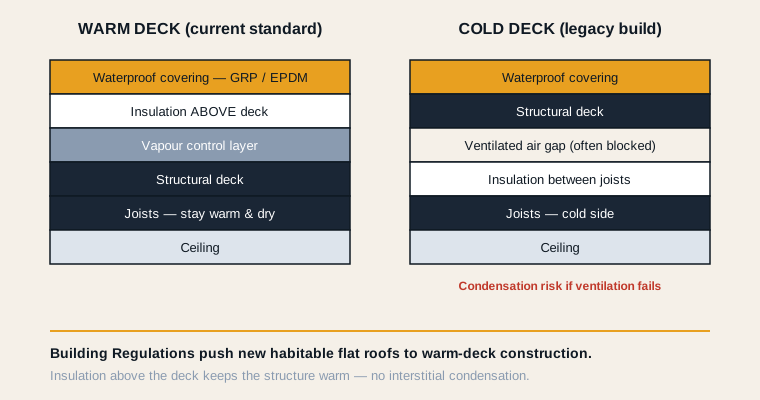
A warm deck flat roof places the insulation above the structural deck, between the deck and the waterproof covering. This keeps the entire roof structure — joists, deck, and the air space below — warm and dry. The covering sits on top of the insulation, protected from thermal cycling by the insulation's mass.
The build-up from bottom to top: ceiling → joists → structural deck (plywood or OSB) → vapour control layer → rigid insulation boards → waterproof covering (GRP, EPDM, or single-ply).
A cold deck places insulation between the joists, below the deck. The deck itself is exposed to temperature extremes. A ventilated air gap between the insulation and the deck is supposed to prevent condensation — but in practice, this gap is often inadequate, blocked, or absent entirely.
Cold deck roofs were the standard before Building Regulations tightened thermal and condensation requirements. They are no longer acceptable for new habitable flat roofs. However, thousands of East London properties — particularly 1960s–90s rear extensions across Hackney, Bow, and Walthamstow — still have cold deck flat roofs that are now failing.
No condensation risk: Because the deck stays warm, warm moist air from the room below never meets a cold surface. There is no dewpoint within the structure. Cold deck designs rely entirely on ventilation to remove moisture — if the vents block (which they do), condensation forms on the cold deck underside, rots the timber, and drips onto the insulation below.
Better thermal performance: Warm deck insulation is continuous across the roof area with no thermal bridges. Cold deck insulation sits between joists, leaving the joists themselves as thermal bridges that reduce overall U-value.
Longer covering life: The waterproof covering on a warm deck is insulated from temperature extremes. On a cold deck, the covering experiences the full daily temperature swing — expanding and contracting, ageing faster.
Building Regulations compliance: Part L (Conservation of fuel and power) requires a maximum U-value of 0.18 W/m²K for flat roofs. Warm deck construction achieves this with 100–120mm of PIR insulation. Meeting this U-value with cold deck construction requires impractically deep joists or significantly more insulation.
A warm deck flat roof replacement costs £80–£105/m² for GRP fibreglass or £65–£90/m² for EPDM rubber (London rates). This includes: stripping the old covering, inspecting and repairing the deck, installing a vapour control layer, fixing tapered insulation boards (creating drainage falls), and applying the waterproof covering.
Typical East London job: A Victorian terrace rear kitchen extension in Hackney, 18m²: strip existing felt, deck repairs, vapour control layer, tapered PIR insulation, GRP covering, edge trims and upstands. Total: £3,000–£3,800 with a 25-year guarantee.
Yes. When a cold deck flat roof fails and needs replacing, converting to warm deck is the standard recommendation. The old covering is stripped, the deck is inspected and repaired or replaced, and the warm deck build-up is installed on top. The only consideration is the increased roof height: 100–120mm of insulation raises the roof level, which may affect the threshold at patio doors or the minimum height above window heads.
We assess this during the survey and discuss options if the height increase creates issues. In most cases, the increase is accommodated within existing tolerances.
Tapered insulation boards are cut at a slight angle, creating the drainage fall that prevents ponding. This means the insulation does double duty: thermal performance AND water management. No separate firring strips or timber falls are needed. The result is a cleaner, lighter, more efficient roof build-up.
BS 6229:2018 specifies a minimum fall of 1:80 for flat roofs. Tapered insulation is the most reliable way to achieve consistent falls across the entire roof area.
Flat roof failing? Call 0203 441 9626. We install warm deck GRP and EPDM flat roofs across East London with a 25-year guarantee.
Will the raised roof height cause problems? In most cases, no. The 100–120mm increase is within the tolerance of existing door thresholds, window head clearances, and rainwater goods. We check during the survey and discuss any adjustments needed.
Can I keep the old deck? If the existing plywood or OSB deck is sound (dry, flat, no delamination), it can be reused as the base for the warm deck build-up. If it is soft, wet, or uneven, we replace it. Deck condition is assessed during the survey.
What insulation do you use? Polyisocyanurate (PIR) rigid boards — Kingspan, Celotex, or equivalent. PIR has the highest thermal performance per millimetre of any commonly available insulation, keeping the total build-up height to a minimum.
How long does the work take? A typical Victorian terrace rear extension (15–20m²): 2–3 days. Larger areas: 3–5 days. We tarp any exposed areas every evening.
Does the work need Building Regulations approval? A like-for-like flat roof replacement does not need Building Regulations. However, if insulation is being added or upgraded (which it should be), a Building Control notification is required. We handle this as part of the project.
Both systems work excellently on a warm deck build-up. GRP is rigid, walkable, and carries a 25-year guarantee — best for areas that will see maintenance foot traffic, dormer tops, and balconies. EPDM is flexible, lightweight, and carries a 20-year guarantee — best for larger areas, garages, and roofs where the lower cost per square metre matters.
We recommend based on your specific situation, not on margin. Both systems are installed by our own trained teams, not subcontracted.
Thousands of East London properties are on their second or third flat roof covering. The pattern is predictable: original felt from the 1960s–80s failed after 10–15 years. It was replaced with another layer of felt (or torch-on felt) in the 1990s–2000s. That covering is now 20–30 years old and failing again. The warm deck GRP or EPDM replacement breaks this cycle — a 25-year guaranteed system that does not need replacing until the 2050s.
One of the greatest advantages of a modern warm deck flat roof is minimal maintenance. GRP and EPDM coverings do not need painting, sealing, or periodic treatment. The maintenance schedule is simple:
Twice yearly: Clear drainage outlets, gutters, and any debris from the roof surface. Check upstands and edge trims for separation or movement. This takes 15 minutes and can be done from a ladder.
Every 5 years: Professional inspection of membrane condition, edge details, and any penetrations (soil vent pipes, overflow pipes, skylights). Cost: £120–£200. Catches minor issues before they become leaks.
Never: Walk on the roof with hard-soled shoes, drag furniture or equipment across the surface, or allow contractors to use the roof as a scaffold platform without protection boards.
Flat roofing is a specialist discipline. A good tiler is not necessarily a good flat roofer — the skills, materials, and detailing are completely different. When choosing a contractor for a warm deck installation, check: are they approved installers for the membrane system they are proposing (GRP or EPDM manufacturers require training and certification), do they provide a manufacturer-backed guarantee as well as their own workmanship guarantee, and can they show you completed warm deck installations in your area?
Our team includes GRP-certified and EPDM-certified installers. Every warm deck installation carries both our 10-year workmanship guarantee and the membrane manufacturer’s 20–25 year product guarantee.
Ready to replace your flat roof with a warm deck system? Call 0203 441 9626. Free survey, written quote, and expert recommendation for your specific roof.
A warm deck flat roof with 100–120mm PIR insulation achieves a U-value of 0.18 W/m²K or better — meeting current Building Regulations. On a typical 20m² rear extension, this reduces heat loss through the roof by 70–80% compared to an uninsulated or poorly insulated cold deck. In practical terms, your heating bills for the rooms below the flat roof drop noticeably from the first winter after installation.
For landlords, improved thermal performance also reduces condensation and mould risk in the rooms below — addressing one of the most common tenant complaints in East London rental properties and strengthening the landlord’s fitness-for-habitation position.
Expert advice from our East London roofing team. This guide draws on 20+ years of hands-on experience across Hackney, Stratford, Bow, Walthamstow, Barking, Ilford, Romford, and all surrounding areas.
For specific advice about your property, call 0203 441 9626 for a free assessment. Every situation is different, and the best advice comes from looking at your actual roof.
Last reviewed: 2026-08-05
Call 0203 441 9626 for free advice from our East London team.
Yes. No call-out fee. No obligation. Detailed written quotes.
All East London boroughs. E, IG, RM postcodes.
24/7 emergency service. Call 0203 441 9626.
10-year written workmanship guarantee on all work.
£5m public liability. NFRC registered.
20+ years in East London. 163 verified five-star reviews.
No call-out fees. No obligation. Just an honest quote from a local East London roofer who’ll turn up when they say they will.
020 3959 2819