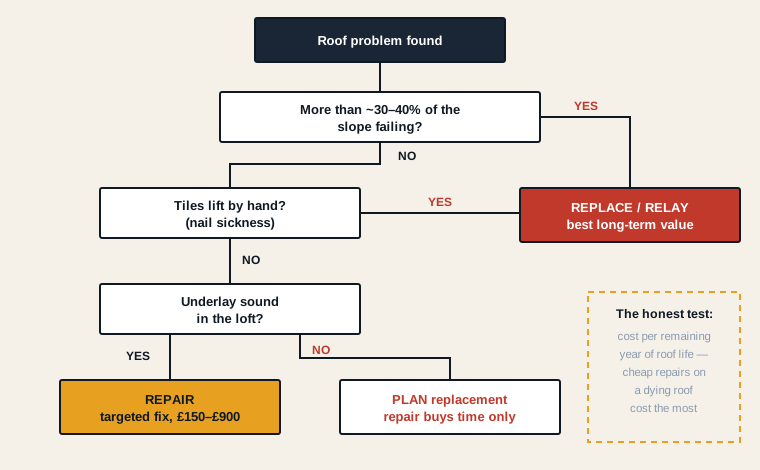
The 30% Rule
If fewer than 30% of your tiles or slates are damaged, slipping, or porous, targeted repair is the right call. If more than 30–40% are affected, ongoing patch repairs become more expensive than a one-off replacement within 3–5 years. We assess this during our free survey and give you an honest percentage.
The Three Tests
Test 1 — Covering condition: How many tiles or slates are cracked, slipped, missing, or porous? Under 30%: repair. Over 30%: lean toward replacement.
Test 2 — Fixings condition: Can tiles be lifted by hand? If yes, nail sickness has weakened the fixings and a full strip-and-relay is needed — each tile must be re-fixed with new nails.
Test 3 — Underlay condition: Check from the loft. If the felt or membrane beneath the tiles is brittle, torn, or absent, water is reaching the timber structure even where tiles look sound. Failed underlay usually means replacement.
The Cost Comparison
Annual repairs averaging £500 over 15 years = £7,500 total with no guarantee and an ageing roof. A new mid-terrace slate roof = £5,500–£9,500 with a 10-year guarantee and an 80–150 year lifespan. Over any reasonable timeframe, the replacement wins — unless the roof has decades of life remaining.
When Repair Is the Right Call
Isolated storm damage on an otherwise sound roof. A few slipped slates where the rest are firmly fixed. A single valley or flashing failure on a roof with good covering and underlay. Any roof that is under half its expected lifespan and in generally sound condition.
East London Specifics
Victorian slate (Hackney, Bow, Bethnal Green): Welsh slate lasts 100–200 years. The slate itself is usually reusable — the problem is corroded iron fixings (nail sickness). A strip-and-relay re-fixes your original slates with copper nails. 70–85% of the slate goes back on.
1930s concrete tile (Ilford, Romford, Barking): Design life 40–60 years. Most are now 85–95 years old. If they’re porous and shedding granules, replacement is the only durable option.
Becontree Estate (Barking, Dagenham): Original hand-made clay tiles from the 1920s–30s are crumbling. Timber battens are rotten. Nearly all need full replacement — repair is short-term at best.
The Cost-Per-Remaining-Year Test
This is the honest metric professional roofers use internally. Divide the total cost of the repair by the number of years it will realistically last. Then compare that to the cost of replacement divided by its expected lifespan.
Repair example: A valley rebuild costs £700 and lasts 15 years = £47/year.
Replacement example: A full re-roof costs £8,000 and lasts 60 years = £133/year.
In this case, repair is clearly better value — the valley is the only failing element. But change the scenario:
Multiple repairs: Annual repairs averaging £500 on a roof that needs replacing within 5 years = £500/year for 5 years of declining roof, then £8,000 for replacement anyway. Total: £10,500.
Replace now: £8,000 for 60 years = £133/year. You save £2,500 AND get 5 more years of guaranteed coverage.
We calculate this for you during the survey. The numbers do not lie, and we share them transparently.
Material Lifespans in East London Conditions
London's air quality, Thames humidity, and urban microclimate affect material lifespans differently to rural areas:
Welsh slate: 100–200+ years. The slate itself almost always outlives its fixings. Nail sickness at 80–130 years requires a strip-and-relay, not a replacement — 70–85% of the slate goes back on with copper nails.
Clay tiles: 60–100 years. Edwardian clay tiles across Walthamstow and Leyton are reaching 100–120 years and still performing where maintenance has been regular.
Concrete interlocking tiles: 40–60 years. The 1930s concrete tiles across Ilford and Romford are at or past their limit. Porosity increases with age, frost cracking accelerates, and granule loss exposes the cement matrix.
GRP flat roof: 25–50 years. The newest technology with the longest guarantee period (25 years).
EPDM rubber: 25–40 years. Proven track record, especially on larger areas.
Felt flat roof: 10–15 years. The shortest lifespan. Budget option only.
Lead flashings: 60–100+ years when correctly dressed and Code 4+ thickness. Theft is a bigger risk than material failure in East London.
What Happens During a Strip-and-Relay
If the decision is replacement, here is what the process looks like on a typical Victorian terrace in Hackney or Bow:
Day 1: Scaffold erected. Existing slates stripped and sorted — sound slates stacked for re-use, broken slates disposed of. Battens and underlay removed. Full timber inspection: every rafter, purlin, wall plate, and ridge board examined. Rotten or weakened timbers marked for replacement.
Day 2: Timber repairs carried out. New breathable membrane rolled out (replaces old felt, allowing moisture vapour to escape while blocking wind and rain). Treated softwood battens fixed at the correct gauge for the tile or slate size.
Day 3–4: Slates or tiles fixed with copper or stainless steel nails. Valleys lined with Code 5 lead. Chimney flashings dressed and stepped into mortar joints. Ridge tiles fixed with dry ridge system (mechanical clips, not mortar). Hip tiles fixed with dry hip system.
Day 5: Final fixes, cleanup, scaffold strike. Site inspection with the homeowner. Written guarantee handed over.
Throughout: exposed areas tarped every evening, debris sheeted, gutters protected from tile fragments.
The Phased Approach
If your roof needs replacing but budget is tight, a phased approach can work. On a Victorian terrace with two main slopes, we can strip and relay the weather-facing slope this year and the sheltered slope next year. Each phase is a complete, weathertight job with its own guarantee. This halves the upfront cost while prioritising the side that is failing fastest.
On hipped roofs (common on 1930s semis in Ilford and Romford), phasing by slope is more complex due to shared hips and valleys. We can still do it, but the per-phase cost is slightly higher than a single project because of the temporary junction detailing needed at each phase boundary.
Insurance Considerations
Buildings insurance covers sudden events (storm damage, fallen trees, impact) but not gradual deterioration. If your roof is in poor condition and a storm causes additional damage, the insurer may argue the storm merely accelerated an existing failure and reduce the claim accordingly.
Conversely, a new roof with a 10-year guarantee reduces your insurance risk profile. Some insurers offer reduced premiums for properties with recently replaced roofs. The guarantee documentation we provide is accepted by all major UK insurers.
Adding Value When You Replace
A roof replacement is a once-in-40–100-year opportunity to upgrade. While the roof is stripped, adding or upgrading insulation costs a fraction of retrofitting later. Installing a dry ridge and dry hip system eliminates future mortar maintenance. Replacing fascias and guttering during a re-roof saves a separate scaffold hire. We identify every opportunity to add value during the quote stage so you can make informed decisions about the scope.
Call 0203 441 9626 for a free survey. We’ll tell you honestly whether repair or replacement makes more sense for your roof.
What About Flat Roofs?
The repair-or-replace decision is simpler for flat roofs because lifespans are shorter and failure modes are more predictable. Felt flat roofs last 10–15 years. If yours is older than that and leaking, replacement with GRP (25-year guarantee) or EPDM (20-year guarantee) is almost always the right call. Patching a 15-year-old felt roof costs £230–£500 and buys 1–2 years at best. Full replacement costs £65–£105/m² and solves the problem for a generation.
The exception: if a flat roof is under 10 years old and the failure is isolated (a puncture, a single failed upstand, a blocked outlet), repair is the obvious choice. The membrane has decades of life remaining — there is no reason to replace it for a localised fault.
Getting a Second Opinion
If a roofer tells you that you need a full replacement, get a second opinion. Not because the first roofer is necessarily wrong, but because a £6,000–£15,000 decision deserves two professional assessments. A good roofer welcomes scrutiny — if their diagnosis is correct, the second opinion confirms it and gives you confidence. If their diagnosis is wrong, the second opinion saves you thousands.
We provide free assessments and are happy to be either the first or second opinion. We would rather give you honest advice that loses us a sale than win a job you do not need.
Questions to Ask Any Roofer
What percentage of the covering is failing? This is the key metric. Under 30% = repair territory. Over 30–40% = replacement territory.
What is the condition of the fixings? If nails are corroded (nail sickness), individual tile replacement is pointless — every tile will eventually slip.
What is the condition of the underlay? If the underlay has disintegrated, the roof has no secondary waterproofing. Any tile displacement causes an immediate leak.
How many more years will repair buy me? An honest roofer will give you a range. If the answer is "2–3 years before you are back where you started," the maths favours replacement now.
What would you do if this were your house? The most revealing question. An honest answer cuts through the sales pitch.
We have been making this assessment for 20 years across every East London property type. Our advice is always the same: honest, evidence-based, and in your financial interest, not ours.
Not sure whether to repair or replace? Call 0203 441 9626. Free survey, honest assessment, no pressure. We will tell you what your roof actually needs.